
Attention in multi-view 3D models isn’t sparse. It has jobs.
VGGT-Ω turns unposed photos into cameras, depth and 3D points in one forward pass, but its global attention gets expensive fast. RAWATTA makes it 2.08× faster than the released code without retraining: 1.61× from a new CUDA engine and 1.29× from the method itself.
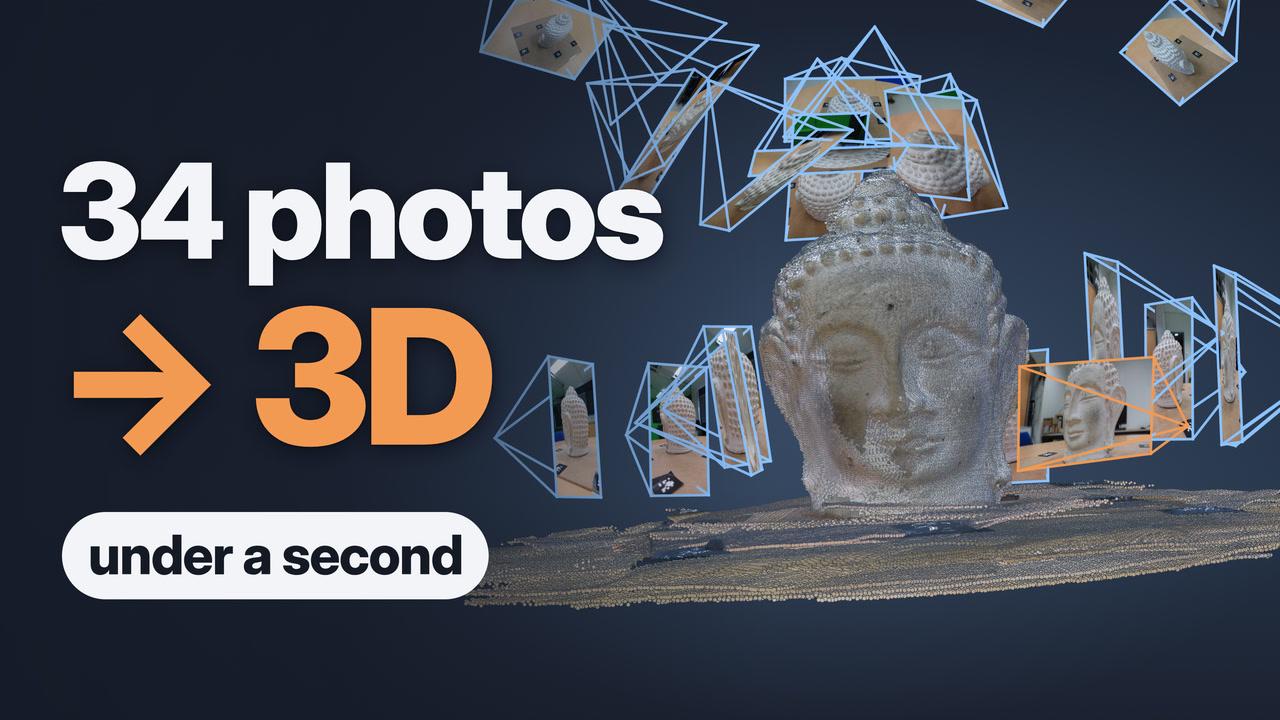
Imagine we have 34 photos of the same object, taken by walking around it with a phone. Nobody wrote down where each photo was taken from. The question is how to find every photo’s position and orientation in 3D, plus a depth map and a point cloud, in under a second.
A few years ago that meant structure-from-motion: detect features, match them, estimate poses, run bundle adjustment, wait. Feed-forward models like VGGT changed that. You hand a transformer all the images at once and it predicts cameras, depth and 3D points in a single forward pass.
There’s a catch. Inside the model, every image patch attends to every patch of every other image. Double the number of photos and that global attention costs four times as much. At 200 images it takes 76% of the run time, and on a 12 GB card the released VGGT-Ω code runs out of memory at 100 images.
Sevval Belkis Dikkaya and I wrote a paper, RAWATTA, on making that attention cheaper without retraining the model and without quietly breaking the cameras.
Why the usual tricks don’t transfer
The obvious move is to borrow an accelerator from large language models. Most of them rest on one assumption: each token (here, an image patch) only really looks at a handful of others, so you can skip, drop or merge the rest.
We measured that assumption on VGGT-Ω, VGGT-1B and π³ across seven datasets, and it doesn’t hold. In no global layer of any of the three models does the most-attended image get more than 63% of the attention, and each patch effectively draws on somewhere between 9% and 83% of all the other patches. There just isn’t much to skip. That’s why block-sparse attention only finds about 7–8% sparsity on VGGT-Ω and gets 1.17× faster.
What we found instead is structure. Every global layer does one of three jobs, and each job tolerates a different kind of shortcut.
Each layer averages, matches or anchors
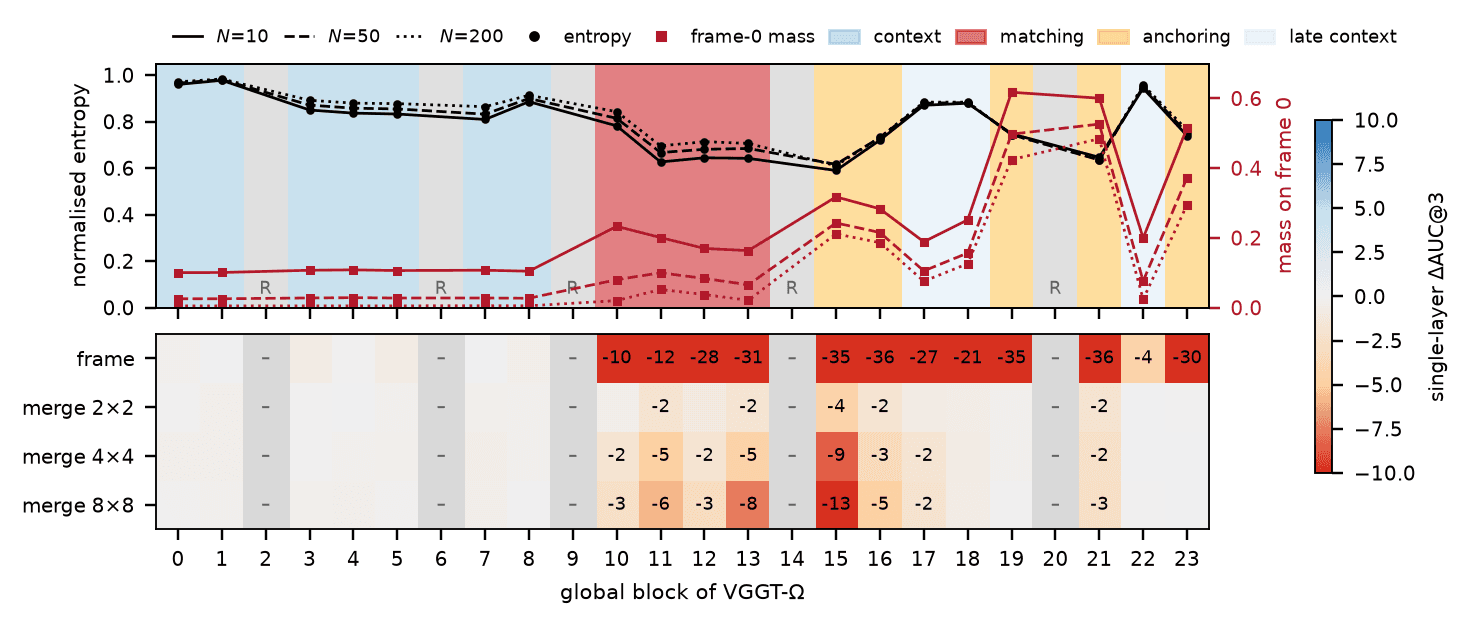
Context layers average over the scene. In blocks 0 to 8, each query spreads its attention almost evenly over every image. These layers are building scene-wide summaries, not correspondences. An average doesn’t change much if each image is summarised by fewer keys, so here you can merge every 4×4 group of patch keys into their mean, and in the earliest layers you can even let each image attend only to itself.
Matching layers find the same point in other images. Blocks 10 to 16 are much more selective, but no single image wins: each query collects evidence from many views. This is where correspondences live, and it’s exactly where key merging hurts. Merging a single block in this range costs up to 9 points of pose accuracy. (We measure that as AUC@3: roughly, the share of camera pairs whose relative angle is right to within 3°.) Applying the fast schedule’s shortcuts to the matching layers instead of the context layers loses 85 points on the worst dataset.
Anchoring layers look at the first image. In blocks 19, 21 and 23, 52–62% of every query’s attention goes to frame 0, the image whose coordinate system all the outputs are expressed in. You can merge keys here, but only if frame 0 keeps all of its own.
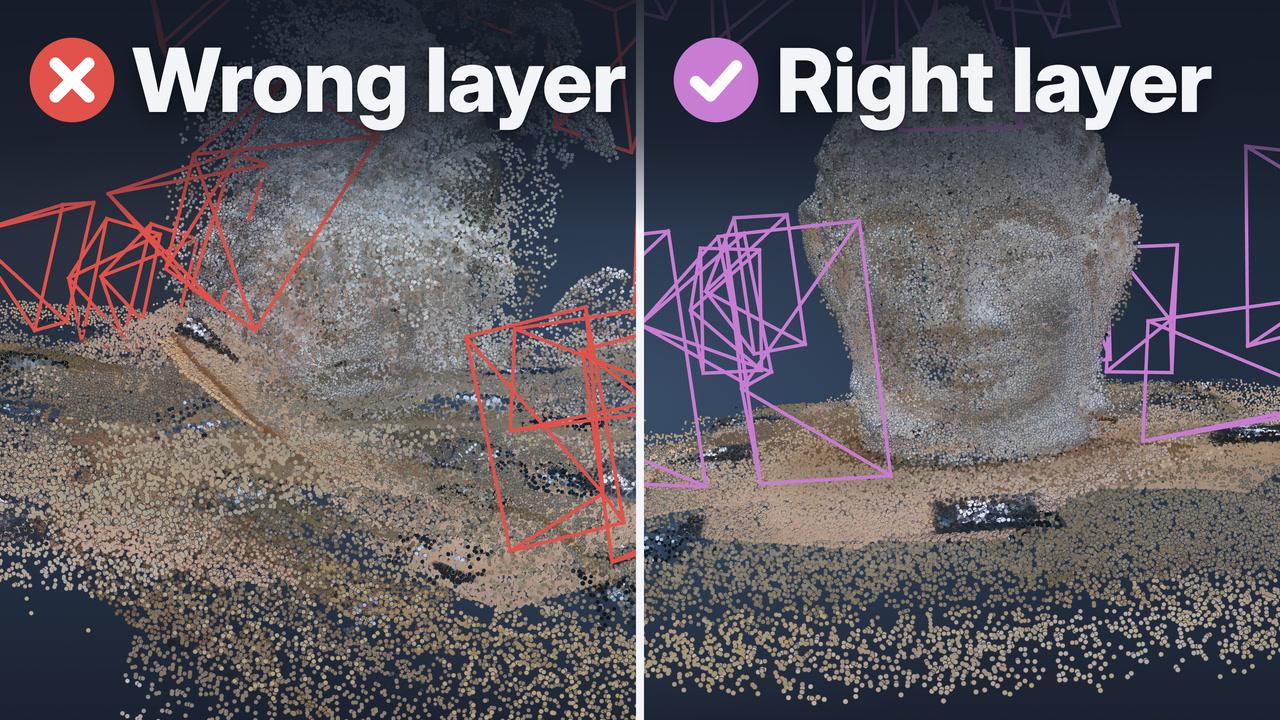
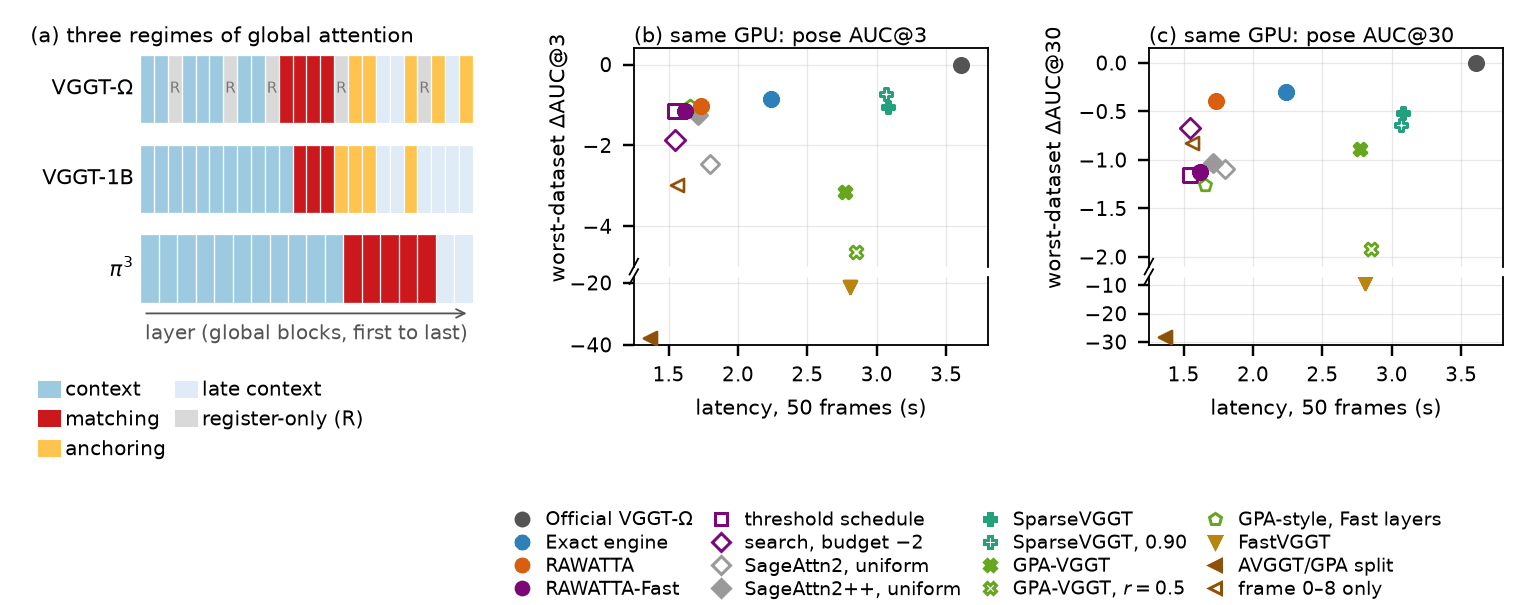
Once you see the model this way, a lot of published results make sense. Accelerators that merge or drop keys in the matching layers are the ones that lose the most accuracy: on the same GPU, GPA-VGGT loses 3.1 points of AUC@3 and FastVGGT loses 21.2.
The safe win is precision. The jobs say where not to cut.
Here’s the part that surprised us. The biggest safe speed-up doesn’t use the three jobs at all.
RAWATTA is training-free. Every operator keeps every query, and the weights don’t change.
RAWATTA, the main setting, runs every dense global attention layer in 8 bit: INT8 for the query-key scores (Q·KT) and FP8 for weighting the values (P·V), following SageAttention. It doesn’t merge or drop anything, in any layer. Which layers need more precision turned out to be the one thing the attention statistics couldn’t predict, so a calibration check decides: starting from FP8 everywhere, we promote layers to 16-bit P·V one at a time until the worst of five calibration datasets is within budget. It stops after two layers, block 15 and block 4.
The three jobs matter for what you must not do. They explain why accelerators that merge keys everywhere lose accuracy, and they tell the faster setting where a shortcut is safe.
RAWATTA-Fast adds those regime-aware shortcuts on top. A greedy search under the same worst-case check accepts frame-only attention on context blocks 0, 4 and 5, and 4×4 key merging on blocks 3 and 19. Matching layers stay dense, and frame 0 always keeps every key.
The worst-case check matters more than it sounds. Errors from individual layers don’t simply add up, and an average over datasets lets a big loss on one dataset hide behind small gains on the others. So a configuration only passes if the worst dataset stays within budget.
The other half of the speed-up is plumbing. PyTorch’s attention falls back to slower kernels when you give it the merge bias, and FlexAttention can’t take INT8 or FP8 operands, so the whole model runs in a native Rust + CUDA engine with our own attention kernels and a static memory planner.
2.08× at 50 images, mostly from the engine
All of these are from the paper, measured on one RTX 4070 SUPER (12 GB) at 50 images:
| Setting | Latency | vs released code | Worst-dataset ΔAUC@3 vs exact |
|---|---|---|---|
| Released VGGT-Ω code | 3605 ms | 1.00× | – |
| Exact engine (our CUDA engine, no approximation) | 2237 ms | 1.61× | 0 |
| RAWATTA | 1734 ms | 2.08× | −0.51 ± 0.11 |
| RAWATTA-Fast | 1616 ms | 2.23× | −0.80 ± 0.17 |
The accuracy column is the change in pose AUC@3 on the worst of six evaluation datasets, on 10-image sequences, over three frame-sampling seeds. Differences below about half a point are within seed noise.
It’s worth being clear about where the 2.08× comes from: 1.61× is the engine, and 1.29× is RAWATTA itself. Against the released code, RAWATTA loses at most about one point of AUC@3 on any dataset, and 0.86 of that is already there with the exact engine, before any approximation.
The gain grows with more images
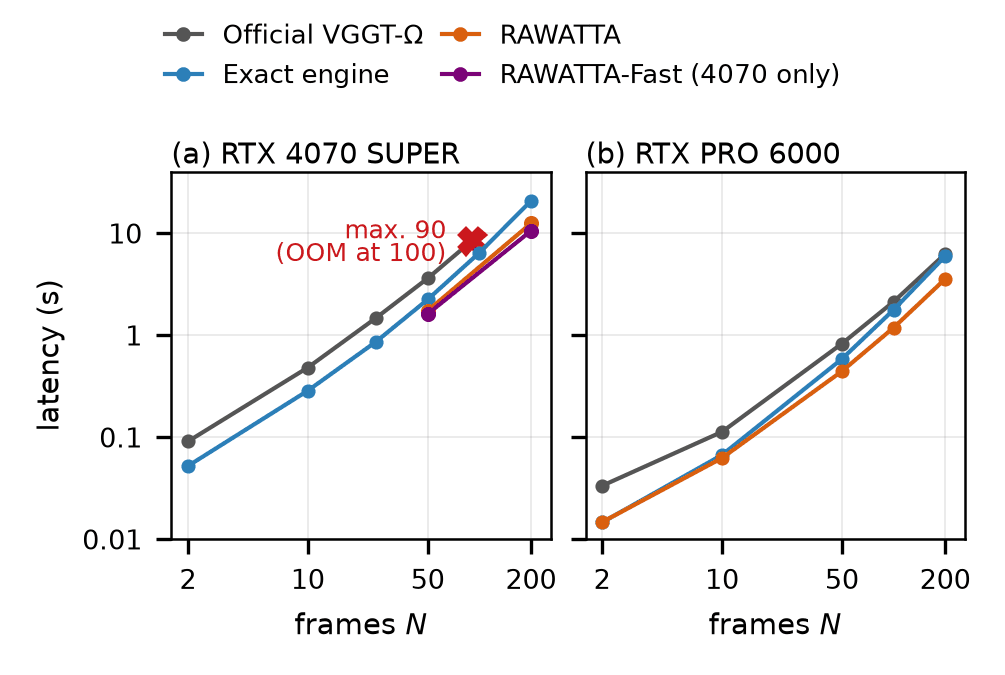
The method pays off more as the image count grows, because global attention takes a bigger share of the time. At 200 images, the exact engine takes 20.7 s, RAWATTA 12.5 s (1.66× from the method alone) and RAWATTA-Fast 10.6 s. Both run at a 9.7 GiB peak on the 12 GB card, where the released code can’t get past 90 images.
Where it doesn’t win
On a large Blackwell card the picture changes. The engine barely helps there (1.05× over the released code at 200 images), and the gain comes almost entirely from the method: RAWATTA is 1.76× faster than the released code at 200 images. At 500 images, GPA-VGGT is faster than RAWATTA. RAWATTA also needs compute capability 8.9 or newer for the FP8 instructions, so RTX 30-series and A100 cards can only run the exact engine. And the calibration is per model: the regimes we found in VGGT-Ω aren’t guaranteed to sit in the same blocks of a different network.
Back to the 34 photos
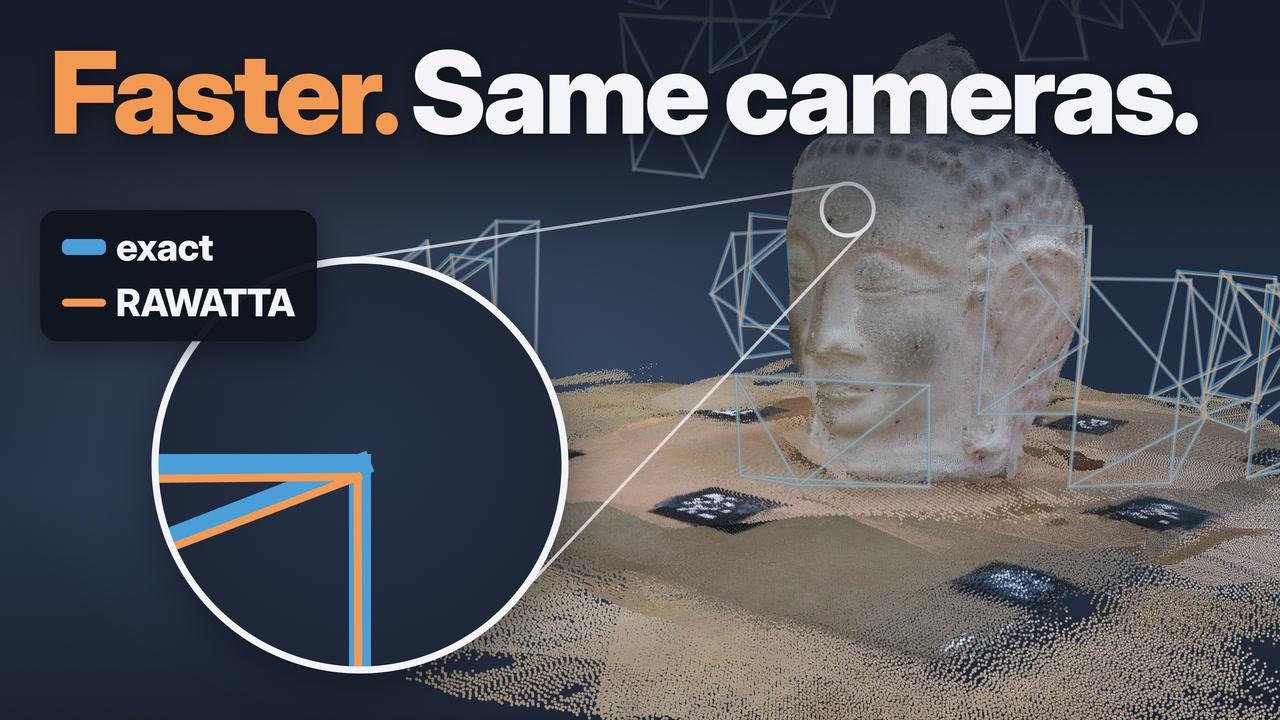
So, can you place 34 photos in 3D in under a second? On the Buddha scene from the opening, in one run on the same 12 GB card, the exact engine took 1063 ms and RAWATTA 897 ms, with the two sets of cameras at most 0.29° apart. That’s one scene measured for this post, not the paper’s protocol, but the answer is yes, without retraining anything.
The code runs from one Docker image
The code is open source: github.com/sezer-muhammed/rawatta. It ships as a single rawatta binary in a Docker image, so the host only needs Docker and an NVIDIA driver. The project page has the full tables, an interactive point-cloud viewer and the setup steps. The paper is on arXiv.
Credits. Code: Apache-2.0. The VGGT-Ω port and the 3D outputs shown here come from the VGGT-Ω weights under the FAIR Noncommercial Research License. Buddha photos: Buddha Dataset, AliceVision, CC BY 4.0, resized and cropped as model input.