
The problem
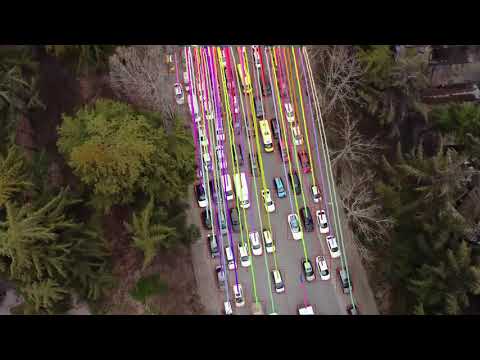
Eflatun AI worked on detecting vehicles and pedestrians in bird’s-eye-view imagery for TEKNOFEST’s Artificial Intelligence in Transportation competition. Overhead perception asks a model to recognize objects from a different perspective than ordinary street photography. Vehicle roofs, small pedestrians, and changing image scale make the training data central to the problem. The project’s public dataset was assembled from stock video and photography, with annotations prepared for object detection. Dataset repository.
My published contribution includes co-authoring that dataset with Şevval Belkıs Dikkaya. The release credits both of us and describes its use by the first- and second-place teams in the 2022 competition. This case study focuses on the data artifact and the inspection pipeline that readers can examine today. Dataset citation.
Turning imagery into reusable training data
The release documents roughly 25,000 aerial images and more than 300,000 annotations. Its class summary names vehicles and pedestrians; its broader description also mentions helipads. The documented package structure includes training and test folders plus a dataset configuration file. Each annotation records a class and a bounding box in YOLO format, which makes the data usable with compatible detection tooling. Release documentation.
That interface is the useful engineering choice: the dataset can be reused independently of a particular application. A researcher can inspect labels, train a detector, and evaluate outputs without reconstructing a private annotation schema. It also separates data preparation from serving, so changes to an inference interface do not require redesigning the annotation format.
The public inference pipeline
A companion Hugging Face demo makes aerial detections inspectable through an image upload interface. It loads a local checkpoint, converts the input to RGB, runs an Ultralytics YOLO detector, and extracts classes, confidence scores, and bounding boxes. The outputs are an annotated image, a results table, and a downloadable CSV. Demo implementation.
The interface includes example images and an adjustable confidence threshold. The export records the chosen threshold alongside pixel coordinates, allowing a reader to connect a visual prediction with its structured result. Model loading happens at application startup. The code also logs loading and inference failures. This is the public demo implementation; it does not establish which detector version or checkpoint was used in the 2022 final. Demo source.
Decisions and tradeoffs
The published artifacts demonstrate a reusable data contract: a recognizable annotation format for training, followed by images and tabular detections for inspecting predictions and using them downstream.
The confidence control also makes a detection tradeoff visible. A permissive setting admits more uncertain candidates; a stricter setting removes low-confidence predictions and may also exclude true objects. A useful review therefore considers missed detections alongside incorrect boxes. The threshold should be selected against the intended operating conditions, with separate attention to pedestrians, vehicles, object size, and scene type.
Outcome and evidence
TEKNOFEST’s official historical results list Eflatun AI in first place for the 2022 Artificial Intelligence in Transportation competition. That is a team result. The public dataset, its authorship record, and the demo source provide separate evidence of the project’s data and software outputs. Official competition results.
Readers can try the detection demo and inspect its source. Example outputs are useful for understanding behavior; representative evaluation is needed to establish accuracy and operational suitability.
Limits and lessons
The public artifacts do not publish the original competition training configuration, a reproducible accuracy benchmark, or hardware-specific latency measurements. The downloadable dataset also needs its class configuration checked before use because the README’s description and class summary differ. A deployment evaluation should establish per-class detection quality and latency on its target hardware.
The lasting lesson is to make perception work inspectable at several levels: the image, its label, the prediction, and the exported record. A clear data contract and a visible inference interface give others a concrete starting point for evaluation and reuse.